
Day Two: Origami

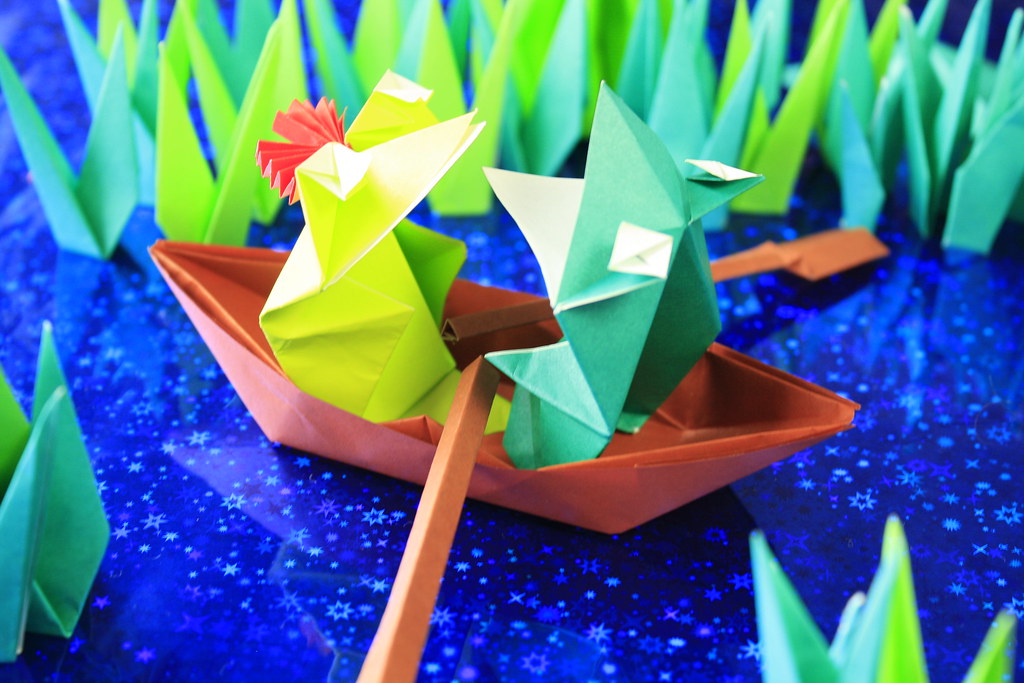
A few weeks ago I stumbled across a Origami kit in Coles, and I decided to pick it up, seeing as it was only $12 for a book and a bunch of origami paper. I've always thought origami is so amazing, but I'd never actually gone out and tried it (besides paper airplanes and hats...but who hasn't tried those?). So I got home and opened it up, and immediately started the easy examples in the book. I have to admit that I did get a bit lost and confused at some points, and wasn't sure how certain things were supposed to fold, but in the end my origami almost looked like the ones in the book.
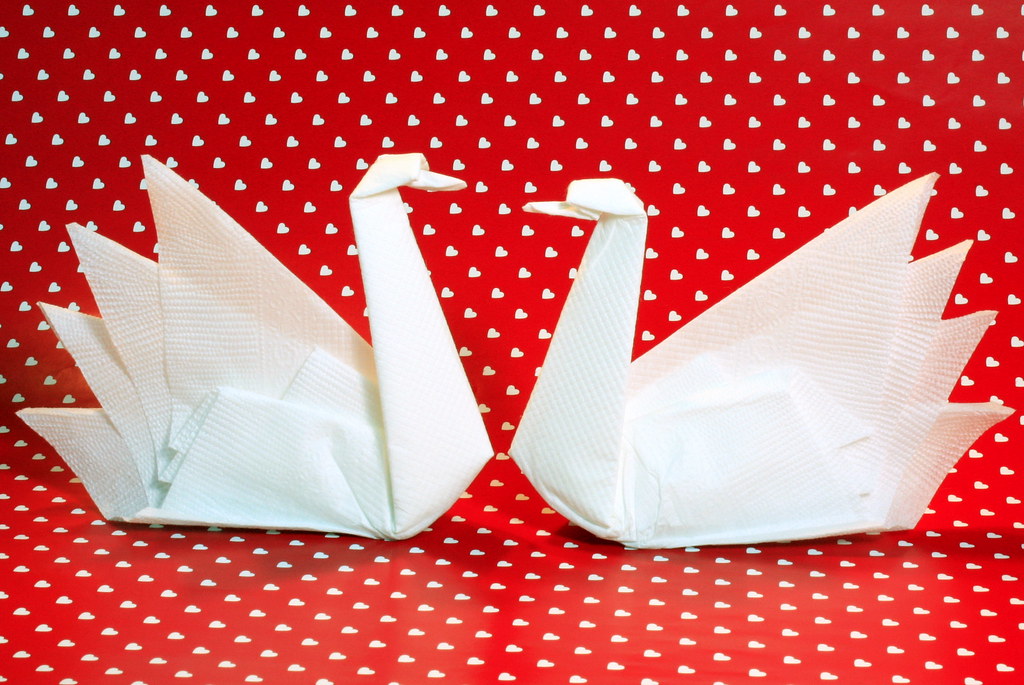
For those who might not know, origami is the Japanese art of folding paper into shapes representing objects (e.g., flowers or birds). Almost any object you can think of, you can make it with origami. Even objects such as envelopes, boxes, coasters, picture frames, bookmarks, photo albums, and much more can be made simply by folding paper. You can also make such animals as lions, ravens, giraffes, swans, and even cute little rabbits and penguins.
Searching websites online is a good way to discover new origami, or if you're stuck you can try looking up a different diagram for it, and in some cases even video's which show step by step how to complete certain pieces. Origami is also becoming more popular in the west, and there are a lot of bookstores and craft stores which sell origami paper, as well as books.
History of Origami
The history of origami is under debate. Unlike other art forms, paper degrades quickly leaving no artifacts to suggest where origami originated and who first invented it. The information listed here provides a good overview of origami but is not an authorative analysis of the subject. For detailed information regarding the history of origami, consult the works of David Lister: The History of Origami in paperfolding.com and the Lister list from British Origami Society.
Textbooks will say that paper was first invented in China by Cai Lun (also written Ts'ai Lun) in 105 A.D. However, archeological evidence suggest that paper was invented even early than this. One can imagine that if there's paper, then the paper may have been folded as well. There is no evidence of this but, if it was true, then paper folding would have started here.
During the 6th century, paper was introduced into Japan. It is here that paper folding became an art form and evolved into what we know today as origami.
Initially, paper was expensive and therefore not available to the general public. Paper folding, was not a hobby: it was for formal functions. For example: "Origami Tsuki" was a folded piece of paper that accompanied a valuable gift and it served as a certificate of authenticity. "Noshi" was folded-paper that accompanied gifts and functioned as tokens of good fortune. "Tsutsumi" was formal gift wrappers. These ceremonial folds were simple and symbolized sincerity and purity. [Photo: noshi collection from the National Diet Library.
Paper folding also developed in Spain sometime between the 8th and 12th century. Historians believe that paper and paper-making was introduced into Europe from Asia via the Silk Route. It is not clear whether paper-folding was invented in Europe independently or if it was also introduced from Asia. Photo: "pajarita"
Paper folding was documented for the first time in 1797 in the book called “Folding of 1000 Cranes“ (Senbazuru Orikata). Next, was a series of books called “Window on Midwinter“ (Kan No Mado). These books were about Japanese customs and there is two sections on paper folding. [The name of these books was probably Kayaragusa]
By 1890's, the word origami was more or less officially used to refer to what we call as origami. Previous to this time, it was called "orikata", "orisue", "orimono", or "tatamigami".
In the 1950, Akira Yoshizana and Sam Randlett developed a standard set of origami symbols to describe how to fold paper into models. These symbols remained essentially the same and is used in origami diagrams today. [Note: David Lister suggests that it was Sam Randlett and Robert Harbin who formalized the use of the origami symbols.]
Currently, there are thousands of published origami books. The art form continues to evolve and is beyond the traditional origami that we think of. Origami styles and techniques include: technical origami, mathematical origami, contemporary origami, modular origami, wet folding origami, pureland origami, dollar bill origami, and business card origami.
History of Origami quoted from the Origami Resource Center.
Related Links:
Origami Club
Origami.com
Origami Instructions
Origamisan
Day One: Hi My Sweetheart

Hi My Sweetheart Promotional Poster
Chen Bao Zhu, Xue Hai/Lin Da Lang
So, my first post for my project is about a Taiwanese drama called 'Hi My Sweetheart'. I've been watching it via Mysoju.com (Hi My Sweetheart videos linked at the bottom of the post in Related Links) since the beginning of December, and I'm completely hooked. Not only do I love Rainie's acting, and for my first time seeing Show Lo acting, I'm impressed by his as well. And of course, since I am a fan of the Pink Panther cartoons, I can't help but love Lin Da Lang and the shows Pink Panther dance.
There are a lot of little things that really make this show stand out to me, not just the acting, but also the soundtrack, the little animations and random comedic moments where Xue Hai is talking to himself and momentarily reverts back to his Lin Da Lang voice. All in all, I think it's a great show, and I can't wait until more episodes are out.You can read more below, or check out the links at the bottom of the post if you'd like to watch the episodes already out (the show is still airing on tv, so you can only watch up to episode 9 currently).
This part may contain spoilers!
'Hi My Sweetheart' is a funny and touching show about the sheltered geek Xue Hai (known as Lin Da Lang to his schoolmates) and his first love, the school bully Chen Bao Zhu. Chen Bao Zhu is a tough girl that nobody wants to be friends with, but the naive Xue Hai befriends her and begins to see a different side of Chen Bao Zhu that his schoolmates are unaware of. A few days before their graduation, Chen Bao Zhu is in a bad accident, and misunderstandings cause the two to lose contact. Thinking that he has been dumped by the love of his life, Xue Hai transforms himself into a playboy, and Chen Bao Zhu moves out on her own to Taiwan with the help of her high school senior, Yan Feng.Title: 海派甜心 / Hai Pai Tian Xin
English title: Hi My Sweetheart
Also known as: Play Boy and Sweetheart / Shanghai Sweetheart
Genre: Romance, comedy
Broadcast network: CTS / GTV
Broadcast period: 2009-Nov-01 to 2010
Air time: Sunday 22:00 - 23:30
Opening theme song: Head Over Heels in Love (愛瘋頭) by Show Lo
Ending theme song: Rain Love (雨愛) by Rainie Yang
Synopsis
Xue Hai was a certifiable dork when he first arrived in Shanghai. After his schoolmate Bao Zhu saved him from bullying, she became his first love. Then, a misunderstanding caused them to lose contact when she moved back to Taiwan. He thought she dumped him. So he transformed himself from a dork to a hunk in order to seek revenge.

Hi My Sweetheart Promotional Poster
Yan Feng, Chen Bao Zhu, Xue Hai/Lin Da Lang
Cast
Main Cast
Show Lo as Xue Hai / Lin Da Lang
Rainie Yang as Chen Bao Zhu
Lee Wei as He Yan Feng
Maggie Wu as Mo Li
Extended Cast
Nikki Deng as Wang Ye Qian
Zhang Yi Mei as Li Jia Jia
Fang Fang as Xue Bo
Xiang Yu Jie as Xue Pei
Wang Yue as Wang Yu Lan
Wen Shuai as Chen Run Fa
Jiang Qi Lin as Ba Shuang
Liu Rui as Wu Ke
Chen Bi Wei as Gao Gang
Yin Chong Zhen as Hui Min
Shi Zhen Long as A Gen
Xie Li Jin
Chocolate Lai
Production Credits
Producer: Chai Zhi Ping
Director: Lin He Long
Related Links:
Wikipedia - Hi My Sweetheart
Drama Addicts Wiki - Hi My Sweetheart
Watch Hi My Sweetheart on Mysoju
What is the Year of Love Project?
Simply put, I am going to write a blog post everyday for a year about something I love. After watching the movie Julie & Julia, and realizing I needed something to help me get away from the winter blues, I decided that a blog would be a good idea.
So everyday, I'll be making a post about something that makes me smile, laugh, feel excited, or cheer me up. It could be anything from a movie I can't get enough of, or a video game I've played so many times I had to buy a new copy after the original one. This is of course, a lot easier than cooking 500 and some recipes in a year, but for me I figure it's a good goal (and I really hate cooking, so thats out of the question). I also hope that in the process I'll be able to see life in a more positive light everyday, and get over my habit of procrastinating. Since if I just don't want to post for a day the project is well, doomed.
So everyday, I'll be making a post about something that makes me smile, laugh, feel excited, or cheer me up. It could be anything from a movie I can't get enough of, or a video game I've played so many times I had to buy a new copy after the original one. This is of course, a lot easier than cooking 500 and some recipes in a year, but for me I figure it's a good goal (and I really hate cooking, so thats out of the question). I also hope that in the process I'll be able to see life in a more positive light everyday, and get over my habit of procrastinating. Since if I just don't want to post for a day the project is well, doomed.